Product Description
Our new printed training booklets replace the former online modules and allow you to learn at your own pace without digital distractions. Customized bulk-purchase options are offered for facilitated trainings only. Contact us to discuss the best fit for your organization.
This training is grounded in the interview process and expands to front-line roles, where people are often meeting each other for the first time. Much of this training can be adapted to roles working with new customers, patients, students and their families, or community members.
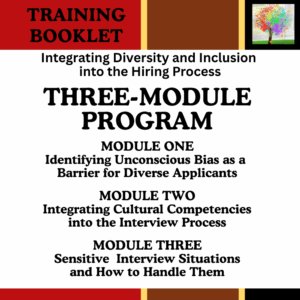
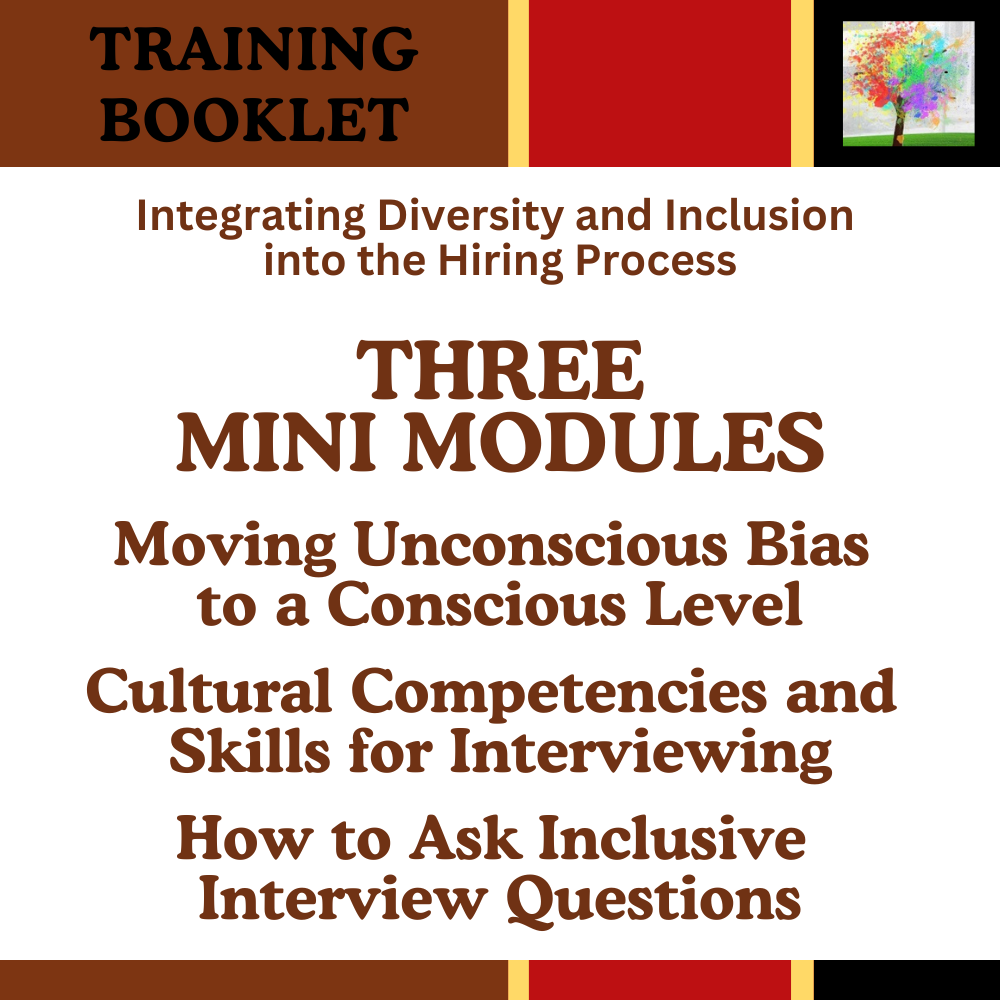
Integrating Diversity and Inclusion into the Hiring Process―Mini Modules Full Program
This Mini Modules program includes three shorter trainings taken from key lessons in the more comprehensive Main Modules and focuses on racial/ethnic diversity.
Moving Unconscious Bias to a Conscious Level
This Mini Module contains a portion of the material from Lessons 1, 2, 3 and 4 in Module One of the Main Module Program, with a focus on racial/ethnic diversity. This training defines culture and identifies unconscious bias at both the individual and systemic levels.
Learning Objectives
- Learn key concepts of unconscious bias, cultural differences, and systemic bias and how they can affect interviewing and front-line roles.
- Gain exposure to numerous examples of bias from diverse perspectives and explores ways systemic bias can exist within an interview team, the hiring process, and in front-line roles.
- Explore methods to help interviewers and front-line staff move their bias to a conscious level, reduce or eliminate bias, and remove barriers for individuals of diverse backgrounds.
Cultural Competencies and Skills for Interviewing
This Mini Module contains a portion of the material from Lessons 5 and 6 in Module Two of the Main Module Program, with a focus on racial/ethnic diversity. This training identifies cultural competencies and skills necessary for interviewers to achieve more inclusive interviewing practices.
Learning Objectives
- Learn cultural competencies and skills to see beyond biases and cultural misunderstandings to evaluate individuals on their actual skills, knowledge and abilities.
- Examine appropriate responses to someone unexpectedly disclosing personal information that creates an uncomfortable situation and/or that should not be discussed in an interview.
- Gain insights from diverse individuals on identifying interviewers’ or front-line staff’s unconscious bias and the underlying reasons for their discomfort with diversity.
- Explore how an interviewer’s style can affect an applicant’s responses and identify ways to be more flexible and inclusive.
How to Ask Inclusive Interview Questions
This Mini Module contains material from Lesson 8, and examples from Lessons 7 and 9, in Modules Two and Three of the Main Module Program. Although this mini-module focuses on asking job-interview questions to elicit complete and useful responses from candidates, many of its strategies can also be adapted for other front-line roles that involve interviewing customers, patients, students and their families, or community members.
Learning Objectives
- Examine commonly asked interview questions, interviewers’ expected responses, and reasons why these questions might be difficult for diverse individuals to respond to in the expected manner.
- Explore alternative ways to ask inclusive questions to obtain quality answers from individuals of all cultural backgrounds and to reduce the effects of unconscious bias on hiring decisions.
- Learn methods to help diverse individuals feel more welcomed and comfortable during an interview or in front-line interactions.
Features
- Structured into sequential lessons with reflection prompts throughout each module.
- Presents authentic quotes and real-world examples―gathered from the author’s firsthand research rather than scripted scenarios or fabricated statements.
- Provides a unique approach that helps participants view their actions through the perspectives of diverse individuals―demonstrating how unconscious bias can appear in cross-cultural interactions.
About This Training
Grounded in decades of Lila Kelly’s research and practical experience in diversity and inclusion, the hiring process, and career transition, this training highlights common situations where unconscious bias can appear at both individual and systemic levels.
Recognizing that the effective integration of diversity and inclusion is an ongoing effort, this program serves as a strong foundation—offering insights, strategies, and actionable recommendations that increase awareness, reduce bias, and support sustainable improvements in hiring practices and front-line interactions.
Audience
Hiring managers, supervisors, interviewers, and front-line staff.
“The training was great! I can see us utilizing this as a training tool for managers and supervisors who conduct their own interviewing. I really liked the information on how to re-phrase interview questions to be more inclusive. The critical thinking questions helped me evaluate my own interviewing skills, the people who should be included in interviews, the interview questions, and the things my organization can do to highlight our respect for diversity.” ―Pang, Associate Human Resources Representative, Federal Reserve Bank, Minneapolis, MN
See the Lessons and Sample tabs above for more details.
Stay informed with our newsletter.
Train-The-Trainer and Blended Learning Programs:
- Bring this training in-house to train your hiring managers, interview teams, and front-line staff with our Train-The-Trainer Program
- Take the learning to a deeper level with a facilitated Blended Learning workshop